Rain against the window, your dog staring at you, and you really don’t feel like another long walk. Sound familiar? The good news: you don’t need a cupboard full of dog toys to do something fun together. A towel, a handful of kibble and a bit of imagination will get you a long way.
Below are nine ideas you can try at home. Most of them cost nothing, and you can adapt them for a puppy, an adult dog or an older dog. Mainly, watch what your own dog enjoys. Not every game suits every dog. You’ll find more ideas for play and brain games on The Play Menu.
1. Let your dog search for kibble
Start as simply as possible. Put three or four pieces of kibble in plain sight in a quiet room and use a fixed cue, such as “find it”. Does your dog find them quickly? Next round, spread them a little further apart or half hide them behind a table leg. There’s no need to make it hard straight away.
Ideally, use part of your dog’s normal meal as the reward. That way an everyday mealtime becomes a small game, without automatically adding extra treats.
A common mistake: hiding everything really well on the very first try. If your dog doesn’t understand what you’re asking, searching quickly becomes frustrating instead of fun.
2. Make a towel snuffle roll
Lay a towel flat on the floor, scatter some dry kibble along its length and roll it up loosely. Let your dog work out with their nose how to get to the food. For a beginner, it’s fine to leave the roll slightly open.
Take the towel away once the food is gone. It isn’t a chew toy. If your dog tends to tear up fabric or swallow it, choose a different game.
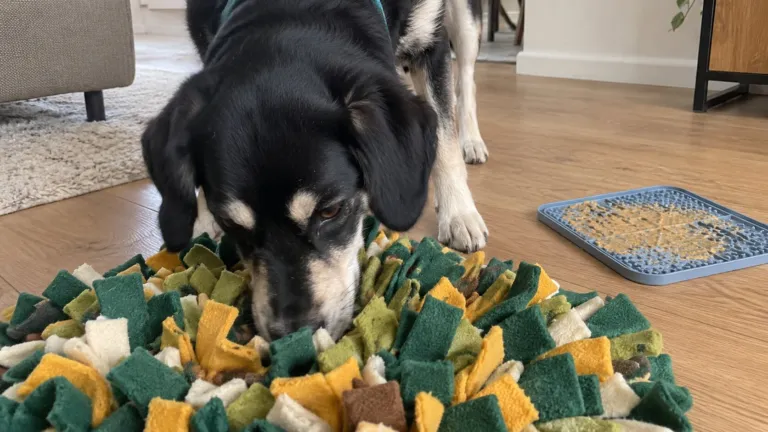
If this goes down well, a snuffle mat might be something for you. In snuffle mat or lick mat: which suits your dog? we explain the difference.
3. Play hide and seek with a favourite toy
Pick a toy your dog gets excited about. First let them watch you put it just behind a cushion or chair, then encourage them to find it. Found it? Reward with a short game.
Once your dog gets the idea, you can hide the toy while they wait in another room. Make sure they don’t have to crawl under anything they could get stuck in, and avoid spots with breakable things.
This works well for dogs who find toys more interesting than food.
4. Try the cup game
Take two or three sturdy, light containers and put a piece of kibble under one of them. Let your dog see where you put it. Can they point to the right one with their nose or paw? Lift it up and hand over the reward.
Start without moving the containers around. Only once your dog understands the game should you slowly swap them over. Don’t use glasses or anything breakable.
5. Teach a small new trick
A few minutes of practice can already be a nice change. Think of touching your hand with their nose, standing on a mat, or going to their bed when asked. Choose one behaviour and reward small steps in the right direction.
A trick doesn’t have to be spectacular. Simple exercises are actually ideal when you don’t have much space. Stop when your dog gets tired or frustrated.
6. Let your dog choose a toy
Put two suitable toys on the floor and give your dog a moment to choose. Then play with the one they picked. Especially if you have lots of toys that just sit in a basket, rotating them can help keep things interesting.
Note: this isn’t a test to prove which toy is “the best”. It’s simply a fun way to find out what appeals to your dog at that moment.
7. Use a simple food puzzle
A sturdy, suitable food puzzle makes your dog do something to get to their kibble. Start at an easy level where they succeed fairly quickly. A puzzle with ten different sliders sounds challenging, but for a beginner it’s mostly confusing.
No food puzzle at home? The cup game or the towel roll work fine instead. Only buy something new once you know what your dog likes.
8. Alternate a short exercise with rest
Not every minute needs filling. Do a short search game first, for example, then let your dog have a drink and offer a quiet place to lie down. Sometimes the most useful thing you can teach your dog is to do nothing for a while.
Restlessness isn’t always about boredom, either. A dog that struggles to be alone, is in pain or is tense doesn’t automatically need more puzzles. Look at what’s behind the behaviour.
9. Play together with one well-chosen toy
You don’t need a pile of stuff. For one dog a suitable tug toy works, for another a soft fetch game or searching for an object together. Choose a game that keeps your living room safe and doesn’t have your dog racing across slippery floors.
Check toys for loose parts, tears or threads, and stay with your dog while they play. Replace broken toys straight away.
What if your dog is done after five minutes?
Then that was probably enough. A dog doesn’t have to spend the whole afternoon on a puzzle. A short activity that goes well is worth more than a long session that leaves your dog irritated. Mix sniffing, playing together, moving and resting.
And even on a rainy day, walks and sniffing outside still matter. Indoor games are an addition, not a standard replacement for exercise and toilet breaks.
Mia’s tip
You don’t need to buy anything straight away. Start with the cup game or a towel and see what your dog enjoys first.
Which game will you try today?
Has your dog never done a search game? Start with kibble in plain sight or a half-hidden soft toy. Does your dog love sniffing? Try the towel. Already good at puzzles? Then you could offer a simple food toy.
Thinking of buying something for it? Read our guide snuffle mat or lick mat for your dog first. It explains when each one is useful and what to look out for when you buy.